
ICE's Terror of Random Violence Lays Siege to Minneapolis
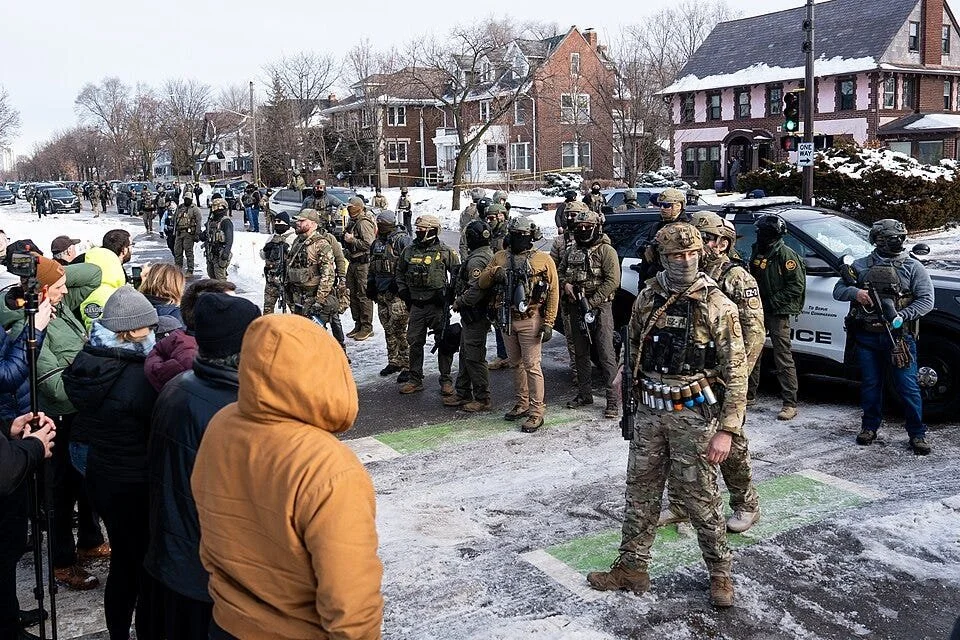
Protestors face off against armed ICE agents on the streets of Minneapolis, Minn. WIKIMEDIA COMMONS: Chad Davis
The randomness of ICE and Border Patrol violence in Minnesota is one of the agencies’ most effective tactics.
The video of Alex Pretti’s murder presents stunning proof. He had been using his cell phone to film protestors scuffling with ICE and Border Patrol agents. Then, swiftly, what begins with Pretti helping a woman whom federal agents had pushed down and targeted with pepper spray, escalates to the agents pinning him to the ground and then firing 10 shots. Agents had already found and appropriated a gun — which the young ICU nurse for Veteran’s Affairs had a legal permit to carry — before they shot their first bullets at him. There was a similar randomness to the Renee Good murder: Soon after Good assures one ICE agent, “I’m not mad at you,” she ends up with a bullet in her brain.
The New York Times columnist, M. Gesson, who grew up in Russia, thoroughly understands the terror whipped up by random violence. This is clear in Gesson’s brilliant Jan. 18 opinion piece, “State Terror Has Arrived”:
… randomness is the difference between a regime based on terror and a regime that is plainly repressive. Even in brutally repressive regimes, including those of the Soviet colonies in Eastern Europe, one knew where the boundaries of acceptable behavior lay.
Open protest would get one arrested; kitchen conversation would not. … editing underground journals would get one arrested; reading these banned works and quietly passing them on to friends probably would not. A regime based on terror, on the other hand, deploys violence precisely to reinforce the message that anyone can be subjected to it.
When we think of the terror regimes of the past, it is tempting to superimpose a logical narrative on them, as though totalitarian leaders had an extermination to-do list and worked their way through it methodically. This, I think, is how most people understand Martin Niemöller’s classic poem “First They Came.” In reality, though, the people living under those regimes never knew which group of people would be designated an enemy of the state next.
It is this gimlet-eyed understanding of state terror that made Gesson’s gripping New Yorker pieces about Russian President Vladimir Putin such critical reading in 2023 and 2024. Her recent post carries the same power:
… In 1934, Adolf Hitler had an estimated 150 to 200 members of the SA’s own leadership arrested and its top generals executed in the ultimate demonstration that no one was immune from the state’s deadly violence. Stalin regularly carried out similar purges. Terror itself was not the end goal of those regimes, but nothing that followed would have been possible without it.
The toolbox isn’t particularly varied. President Trump is using all the instruments: the reported quotas for ICE arrests; the paramilitary force made up of thugs drunk on their own brutality; the spectacle of random violence, particularly in city streets; the postmortem vilification of the victims. It’s only natural that our brains struggle to find logic in what we are seeing. There is a logic, and this logic has a name. It’s called state terror.
Though federal authorities have vehemently resisted and locked out any state efforts to investigate these murders, two leading legal scholars, Barry Friedman and Stephen I. Vladeck, lay out how state and local authorities could hold the Trump administration accountable. As they explain in their Jan. 26 New York Times opinion piece, “This May Be the Only Path to Accountability for the Minneapolis Shootings”:
… state and local prosecutors can prosecute federal officials for violating state criminal laws. Prosecutors should be gathering and securing evidence and seriously considering filing charges — sooner rather than later.
The legal experts admit that these actions may prove difficult, but they press local authorities to make every effort:
Not every prosecution will succeed, and all will face obstacles that are built into our legal system. But critically, bringing these state and local prosecutions could produce deterrent effects that are so desperately needed now. …
If federal officers understood that they could and might well be held liable for outrageous conduct, they might think twice before engaging in it. The ultimate goal is bringing to justice those who have engaged in blatantly unlawful and unconstitutional conduct. But what is needed immediately — urgently — is deterring such conduct from happening going forward. …
We are arguing only for compliance with the Constitution.
Friedman and Vladeck make a point of emphasizing that Trump does not have the power to pardon people convicted by a state.
Yet, the Trump administration must grasp that the seeming randomness of its violence is the most effective way of spreading mass terror.
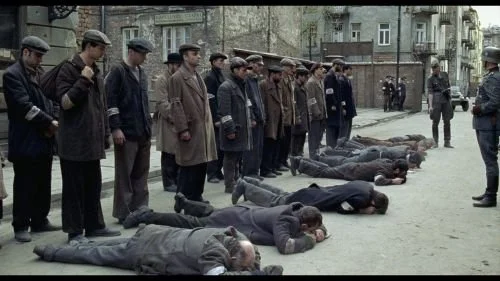
Nazi soldiers apply an arbitrary system to determine which Polish Jews will be the next to die in a scene from director Roman Polanski’s The Pianist. PHOTO: Courtesy Focus Features
Years ago, New York Times film critic A.O. Scott wrote an astute and erudite opinion piece about this topic for me when I was an editor on The NY Times “Week in Review.”
Scott’s piece, “True Horror: When Movie Violence Is Random,” was pegged on the slew of Oscar nominations for director Roman Polanski’s remarkable 2002 film The Pianist, set during the Nazi occupation of Poland during World War II. Polanski lived through this harrowing oppression starting at age six. He was orphaned and struggled to survive, alone in the countryside, from age 10 on. Polanski saw and experienced the sheer randomness of the Nazi terror — German soldiers, for example, once used him for target practice.
In the film itself, as Scott details in his moving piece, the director grapples with how to present such all-encompassing terror:
Polanski’s subject, the Holocaust, still seems to defy all representation. Its horror is so total as to exist beyond the reach of imagination, only to be diminished by attempts to bring it to life. So Polanski chooses instead to suggest the scope of Nazi cruelty by zeroing in on its particular effects.
The violence in the film is not just particular, but random. Workers in the Warsaw ghetto are selected for execution for no clear reason; an old man in a wheelchair is thrown from his apartment window.
The survival of the protagonist comes to seem equally random, and the pianist himself, played by Adrien Brody in the year’s single best screen performance, is not just a being whose physical existence is in peril, but an individual consciousness terrified of being snuffed out. The audience’s dread at witnessing something horrible combines with a more elemental fear, of its own nonexistence. And this interior state of feeling, more than any spectacle of cruelty, brings an unimaginable experience home.
The Pianist won three Oscars that year, including Best Actor for Adrien Brody. Roughly 15 years before the #MeToo movement brought home the serious problem of sexual abuse and rape culture in Hollywood, Polanski won Best Director for his masterful production — though he could not attend the ceremony since he had fled the country in 1978 after raping a 13-year-old girl.
The Trump administration now seems to be seeking to ease the ever-mounting public protests, which are spreading across the nation, by changing out its top representative in Minneapolis. Trump even had what he described as “very good phone calls” with Minnesota Gov. Tim Walz and Minneapolis Mayor Jacob Frey.
The Trump administration has not, however, called off its current criminal investigations into both men.
We’ll see how this all plays out…
On Using Profanity
Some have commented on the profanity commonly used by many protestors today. This is, they assert, unlike protests of years past.
Hmmmm
One esteemed New York Times reporter, who was a good friend of mine, years ago told me a story about covering anti-war protests during the 1960s and early 1970s. Amid one big protest, a flock of nuns appeared, marching along as a group.
On cue, they started chanting: Agnew, Fuck You!
This was something, he told me, that he could not report accurately. That sort of profanity was then not considered news “Fit To Print.”
I somehow doubt it made it onto broadcast news either.